There are many typographic marks which are familiar to most, but understood by few. Most of these glyphs have interesting histories and evolutions as they survived the beatings given to them through rushed handwriting of scribes and misuses through history. They now mostly live on our keyboards and in our software, and a few are used often, so it seems only fitting to know where they come from and how to correctly use them.
The Pilcrow
History of the Pilcrow
 As with many elements of language today, it all started with Latin. While the pilcrow has evolved to resemble a backwards P, this is nothing more than incidental. In its early forms, the pilcrow was a C, a shorthand used for the Latin word capitulum, meaning chapter, mostly in a religious sense, which may be why it isn’t uncommon to see it in use in Biblical texts today.
Replacing another symbol, the paragraphos, to become the new mark representing a paraph—a new line of thought or break in text—it evolved over time through the natural development of handwriting. Initially starting as the C, a slash was drawn through it, perhaps to make it more noticeable, then a second slash was added, and through time the C went from being the vertical centre of the lines, to the top of them. All this ended in what is often now seen as a P backwards.

Using the Pilcrow
Initially the pilcrow was used to separate blocks of text, rather than dividing them with space. While this is, of course, now the normal thing to do, it isn’t impossible to find modern text that do the same as what was originally intended, mostly in an effort to insert a little bit of flair or maybe to serve as a throwback to typesetting that may be seen as a little more classical. An example that is often cited is Eric Gill’s An Essay On Typography. It is also used by proofreaders to denote a paragraph that should be split, and also as a mark used to reference a specific paragraph in legal documents (an example is included in the Section Sign below).
While graphic designers, and especially those outside the field, would have no major need to think about using the pilcrow, it is worth noting that they can be a pleasure to design for our typographic friends.
The Ampersand
History of the Ampersand
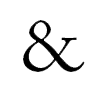 As with the pilcrow, the ampersand has Latin roots. Originally a shorthand mark for et, Latin for and, the ampersand has a very traceable and visible evolution. Simply put, the & is not much more than e and t coming together. The ampersand is a marriage of the two letters, which came about through rushed writings and abbreviation starting at its birth around 45AD.
Through time the symbol has changed to the point where most ampersands are distant cousins of the original et. But there are a few typefaces that have more of a distinct features relating to its ancestry.

An article with a few great shots of early ampersands can be found at the Adobe Fonts site.
Using an Ampersand
The ampersand shouldn’t be used as direct replacement for and. It is best used when pairing names in titles or in a business name.
It is usable in body text when need to indicate multiple couples, such as Gilbert & Sulivan and Rodgers & Hammerstein, but this rule is more of an extension of the above.
Section Sign
History of the Section Sign
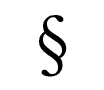 There isn’t much out there for information on the section sign. So the easy speculation to make is that it is two S‘s that came together as a shorthand for referencing a section and that it happened at some point in time.
If you know more, let it be known in the comments and I’ll improve the above.
Using the Section Sign
§15
Most commonly used in legal texts, the section sign is used for referencing. For example, the above would refer you to section 15.
§8—20
Something I love about the Section Sign is that when you need to refer to a range of sections, you use it twice, as above. Why you don’t use it once is beyond me, as it seems somewhat redundant, but if you know otherwise, let me know.
§15, ¶4
And when you are referencing a paragraph within a section, you get to use the lovely pilcrow.
Asterisk
History of the Asterisk
 Originally using six arms, it is now more commonly designed with five. It is a mark most often used to denote a side note.
Like the section sign, not a whole lot is known about the asterisk. The best, and practically the only, piece of historical information I could find was in my Bringhurst Bible, so I’ll let him tell it best:
‘It appears in the earliest Sumerian pictographic writing and has been in continuous use as a graphic symbol for at least 5,000 years.’
Using the Asterisk
Most often used as a superscripted glyph, the asterisk is primarily used for notes, references or to mark a keyword. It can also be used to indicate a person’s birth when appearing with a year—with the dagger indicating death.
Hedera
History of the Hedera
 Another mark for which little information is known, but that may be because it isn’t necessarily an important mark as it’s mostly decoration. The hedera was used in Latin texts as a punctuation mark between paragraphs in long documents, when line breaks weren’t as common, similar to the pilcrow.
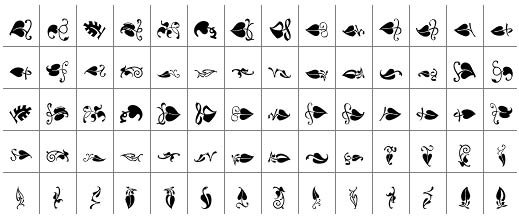
Hedera is Latin for ivy, which isn’t surprising when you see that the hedera is an illustrated ivy leaf. Found in early Greek texts, it makes the marks one of the oldest typographic ornaments.
Using the Hedera
A latin mark used for punctuation, it is now most often used as a
fleuron (a typographic ornament) that is often seen, yet not easily
found.
It is now sometimes, albeit very rarely, used by designers between paragraphs (new lines and space included), for splitting very large lists, such as an index; used between lists of entries for each letter, replacing the appropriate letter as a header.
It may also be used as an opening element of a paragraph when a text-indent is in use, sitting in the open space which would normally be left empty.
Why & When
Knowing why and when these marks came to be isn’t necessary information. But it is useful in a number of ways—it helps us understand the context in which to use these marks, it’s interesting for type nerds (and who isn’t one?) and it will help you justify using these marks when employing them to give a piece of work a little extra flare. At the very least, you might have a few extra terminologies you can throw around when talking to fellow type nuts.
REFERENCES & LINKS
The Lovely Pilcrow
An article at Hoefler & Frere-Jones’ blog about the pilcrow and the joy of designing it.
Adobe Fonts: The Ampersand
Article at the Adobe Fonts site about the lovely ampersand.
The Elements of Typographic Style by Robert Bringhurst
A lot of information for this article was found in The Elements of Typographic Style by Robert Bringhurst.
Copy Past Character
A neat little site that makes it easier to copy/past a lot of special characters, included is the pilcrow, section sign, the daggers and a few others.
Master Your Craft.
Weekly.
Become the designer you want to be.
Join a group of talented, creative, and hungry designers,
all gaining the insight that is helping them make
the best work of their lives.